Is Pentecost the Same as Shavuot?
 By Jon5 min read
Pentecost and Shavuot are the same feast — Acts 2 happened on the fiftieth day of the biblical calendar. Here's what that means for your homeschool.
When someone first discovers the biblical calendar, the question almost always arrives in the same form: Wait — is Pentecost the same as Shavuot?
The short answer is yes. The longer answer is the reason most Christian families never learn that.
Pentecost — the day Acts 2 describes, when the Spirit fell on the disciples in Jerusalem — and Shavuot (the Hebrew name for the same biblical feast, often called the Feast of Weeks in English) are not two separate holidays standing near each other on the calendar. They are one feast. Same morning. Same fiftieth day. Same Jerusalem packed with first-century Jewish pilgrims who had walked up to celebrate.
That single fact rewrites the way Acts 2 reads. And for a homeschooling family, it opens a doorway into one of the most beautiful seasons of the year.
Two Names, One Feast
The confusion is mostly a translation problem.
Shavuot is the Hebrew word the Torah uses in Leviticus 23:15–22. It means "weeks" — seven weeks counted from the Feast of Firstfruits during Passover, ending on the fiftieth day. Pentecost is the Greek word the New Testament uses, and it simply means "fiftieth." When Jewish pilgrims arrived in Jerusalem for that feast, the Greek-speaking world called it Pentecost. The Hebrew-speaking world called it Shavuot. The feast itself was the same.
Same date on the Hebrew calendar (6 Sivan). Same fiftieth day from the wave offering of barley. Same pilgrim feast commanded in Deuteronomy 16:16. The Greek-speaking followers of Yeshua inherited the Greek name, the synagogue kept the Hebrew name, and over the centuries most of the Christian church world forgot they were talking about a feast at all.
But the disciples didn't forget. When Luke writes "When the day of Pentecost came, they were all together in one place" (Acts 2:1), every Jewish reader in the first century would have heard one thing: Shavuot. The feast of the giving of the Torah. The wheat harvest. Two loaves waved before the presence of God.
What Shavuot Was Before Acts 2
To understand what happens in Acts 2, you have to know what the disciples were already there to celebrate.
Shavuot was the second of the three pilgrim feasts. Families traveled to Jerusalem with the firstfruits of the wheat harvest, and two leavened loaves were waved before the Lord at the Temple — the only leavened offering in the entire sacrificial system. Tradition also remembered Shavuot as the anniversary of God giving the Torah at Mount Sinai, exactly fifty days after Passover. The same fifty-day pattern: Passover, then a count, then the mountain.
Two loaves. The Torah given. The wheat harvest. The fiftieth day.
This is the room Acts 2 walks into. Not a random Sunday in spring. A feast already loaded with meaning — and a feast every Jewish person in Jerusalem already knew by heart.
If your family is new to the biblical calendar, our post on Counting the Omer and the Feast of Shavuot walks through the fifty-day count that leads up to this morning.
What Changed in Acts 2
Read Acts 2 with Shavuot in mind and the symbolism reads differently.
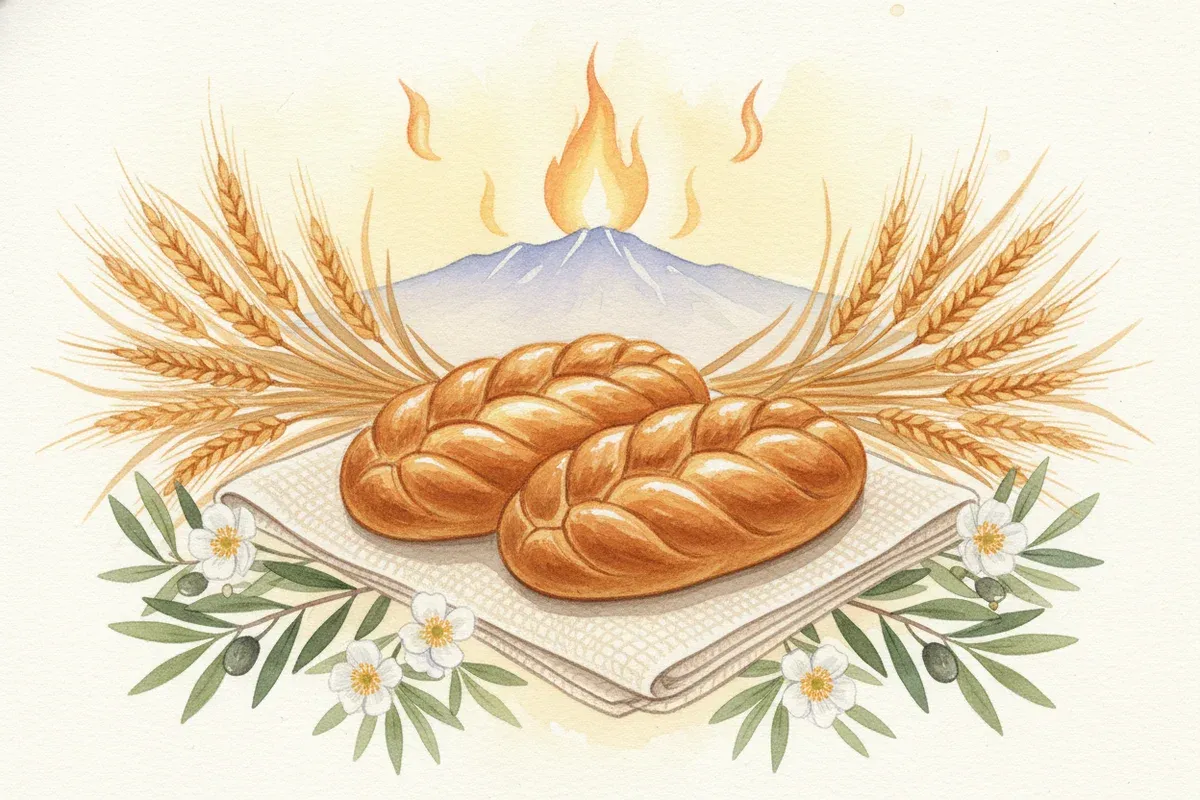
The Spirit falls in tongues of fire — the same fire that wrapped Mount Sinai when the Torah was first given. The disciples speak in every language of the pilgrims gathered in Jerusalem — the same crowd who had come to remember the giving of the Torah to the fledgling nation of Israel. Three thousand are added to the ekklesia on the day Jewish tradition remembers three thousand falling at Sinai after the golden calf.
The pattern is not coincidence. It is the same feast, filled up with new significance.
The Torah that had once been written on stone is now written on hearts (Jeremiah 31:33). The two loaves — leavened, lifted up together — become Jew and Gentile in one body (Ephesians 2:14–16). The wheat harvest that began at the Temple becomes the harvest of the nations.
Pentecost did not replace Shavuot. It is what Shavuot was pointing toward all along.
Why This Matters for Your Family
For a Christian or messianic family, this changes how you celebrate.
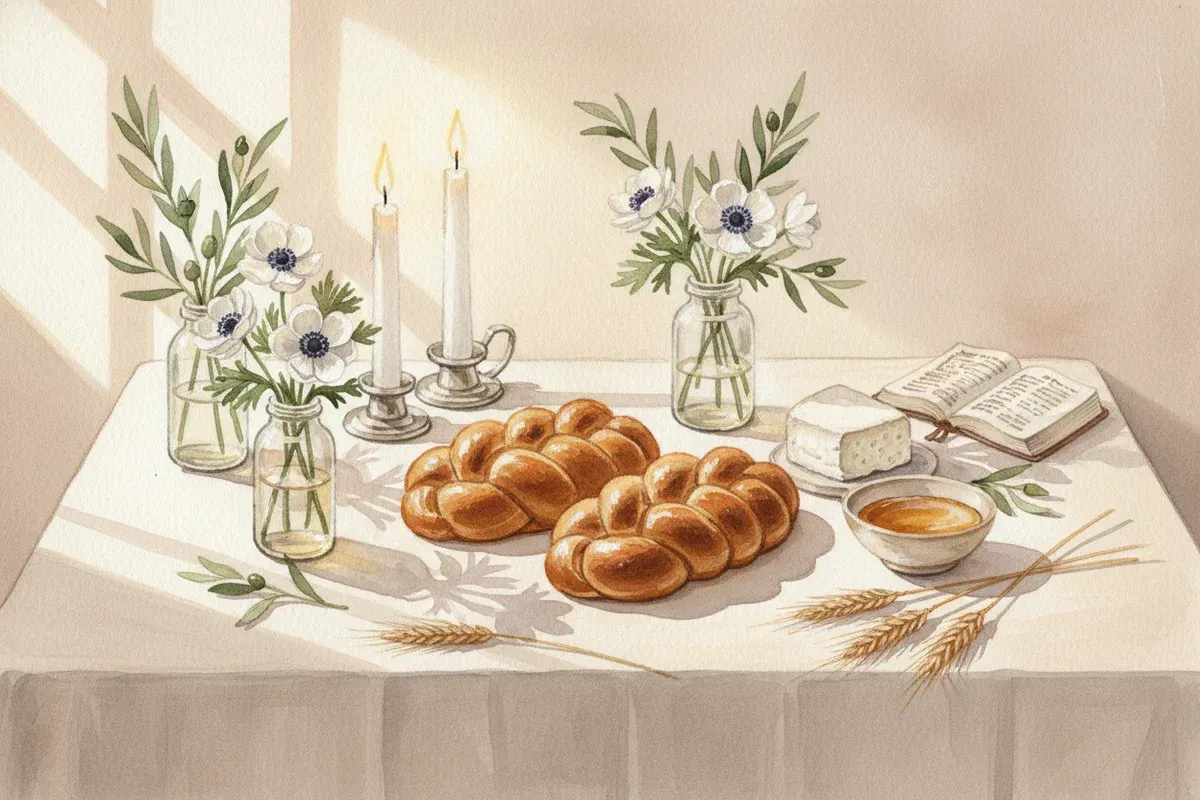
You don't have to choose between Pentecost and Shavuot. They are the same day. You can light candles, decorate your home with greenery (an old Shavuot tradition remembering Sinai), bake two loaves of leavened bread, read the book of Ruth out loud, and read Acts 2 around the dinner table — all in the same evening. The Old Testament and the New are not at odds here. They are in conversation.
For a homeschool family especially, this is a gift. It gives you a feast in late spring with real Scripture, real harvest imagery, real history, and real story to walk your children through. Not a "Christian" feast layered on top of a "Jewish" feast — one feast with one story running all the way through it. (If you want the bigger picture of how this shapes the year, we wrote about why we homeschool with the biblical calendar.)
A few simple ways to begin:
- Read Acts 2 out loud on Shavuot evening. Then read Exodus 19. Let your children notice the fire in both stories.
- Bake two loaves of leavened bread. Talk about why there are two. Jew and Gentile. Lifted up together.
- Read the book of Ruth together in the days leading up. It is the traditional Shavuot reading, and it is the story of a Gentile woman grafted into Israel during the wheat harvest. The connection to Acts 2 is quietly breathtaking once you see it.
- Bring greenery into the house. Branches, wildflowers, anything green. Sinai was a mountain in bloom.
- Walk your children through all three threads of the feast. Our Messianic Shavuot activity bundle for kids gathers coloring pages, scripture copywork, Ten Commandments crafts, Ruth illustrations, and a tongues-of-fire paper craft — Sinai, Ruth, and Acts 2 in one printable resource for ages 4–12.
One Feast, One Story
So — is Pentecost the same as Shavuot?
Yes. Down to the morning. Down to the hour. The disciples were not waiting in the upper room for something new. They were waiting in Jerusalem for a feast their grandparents had walked up to celebrate for centuries — the feast of the Torah, the wheat harvest, the fiftieth day. And on that morning, the God who had once descended on a mountain descended on a people.
Same fire. Same fiftieth day. Same God of Israel. One feast.
And one Spirit who wrote God's Torah on hearts sealing the new covenant.