Rosh Hashanah (Feast of Trumpets) Resources for Kids
You don’t need to be a scholar to teach children the Feast of Trumpets. You need a story, something loud to blow, and a plate of apples and honey—plus hand-illustrated Messianic printables and a simple five-step rhythm for the loudest day on God’s calendar, at home or in the classroom.
Rosh Hashanah, also known as the Feast of Trumpets, is the first of the fall feasts of Israel. Its biblical name is Yom Teruah—a Hebrew word that literally means “day of blasting or shouting.” It’s commanded in Leviticus 23: “In the seventh month, on the first day of the month, you are to have a Shabbat rest, a memorial of blowing (shofarot), a holy convocation” (Leviticus 23:23–24).
That’s nearly the whole command: rest, gather, and make a lot of noise—most often with a shofar, a ram’s horn trumpet. It falls on the first day of the seventh Hebrew month, Tishrei. The name “Rosh Hashanah”—“head of the year”—came later, out of the period of Babylonian exile, when the day became known as the beginning of the Jewish civil new year. Two names, one feast: the biblical day of blasting, and the spiritual new year.
The shofar blast is likened to the arrival of the King for His coronation—trumpet blasts announcing the good news that the King is on the throne. It is also a call to repentance: a sound meant to wake us from spiritual slumber as the Ten Days of Awe begin, counting down to Yom Kippur, the Day of Atonement. And for those who follow Yeshua, the trumpet points forward: the Messiah of Israel said He will return “with a great trumpet” (Matthew 24:30–31). Every shofar blast rehearses that day, and calls us to return to God.
Why Children Love This Feast
This is the loudest day on God’s calendar—and He commanded it that way. Children get to blow horns, shout, eat apples dipped in honey, and throw stones into a creek. Every one of those things carries the meaning of the feast inside it.
Four simple themes run through the day, and they’re the four things you’re teaching:
We turn our hearts to the King.
We recognize His Kingship—acknowledging afresh that Messiah Yeshua is King and belongs on the throne of our lives.
We wake up from spiritual slumber.
We remember—calling to mind the moments, in Scripture and in our own lives, when our Father and King came through for His people with His mighty hand.
The Backdrop: The King Is in the Field
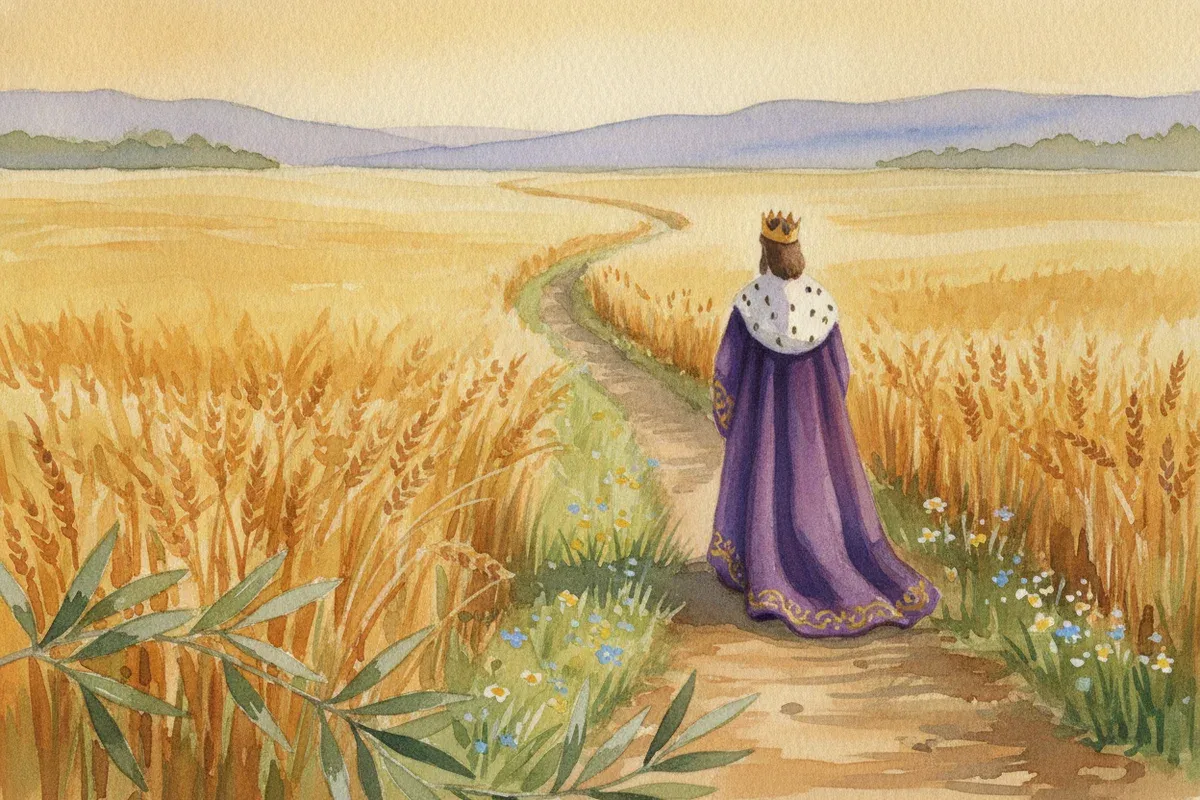
Before you teach the feast itself, tell the children the story of the month that leads to it. The thirty days before the Feast of Trumpets are the Hebrew month of Elul—a season of preparation. And there’s a beautiful Jewish picture connected to it that children grasp instantly: the King is in the field.
Most of the year, a king is distant—sequestered in the royal palace, ruling the land, busy with the demands of protecting his people, far away and inaccessible. But during the month of Elul, the King leaves the capital city and ventures out into the fields, making himself accessible to everyone—including the common people. Those outside the city know he’s coming. They wonder if he might take a detour through their field. So they get things ready and in order, perhaps preparing a gift for their beloved King, hoping to catch a glimpse of his smiling face—that he would turn toward them and show them favor.
That’s what this whole season is: the King has drawn near, and we get our hearts ready to meet Him. The prophet Isaiah says it plainly: “Seek Adonai while He is available, call on Him while He is still nearby” (Isaiah 55:6).
One Hebrew word to teach: Teshuvah (teh-SHOO-vah) means “to return” or “to repent”—and it carries a picture even a four-year-old can act out. Imagine you’re walking one direction, away from the King, doing your own thing. Teshuvah means you literally turn around and start walking back the other way. Have the children walk across the room, stop, turn, and walk back. That’s repentance: turning away from sin and returning to a God who loves us with an everlasting love.
Tell the King-in-the-field story before anything else. Then everything that follows—the shofar, the honey, the stones in the water—answers one question the children now understand: the King is near; how do we get ready to meet Him?
How to Teach the Feast of Trumpets to Kids
This feast has less story on the surface than Passover or Purim—no Exodus, no Esther—which is exactly why children need you to hand them what it means. Here is the rhythm, five simple steps, for the dinner table or the reading circle.
1. Read the command and blow the shofar
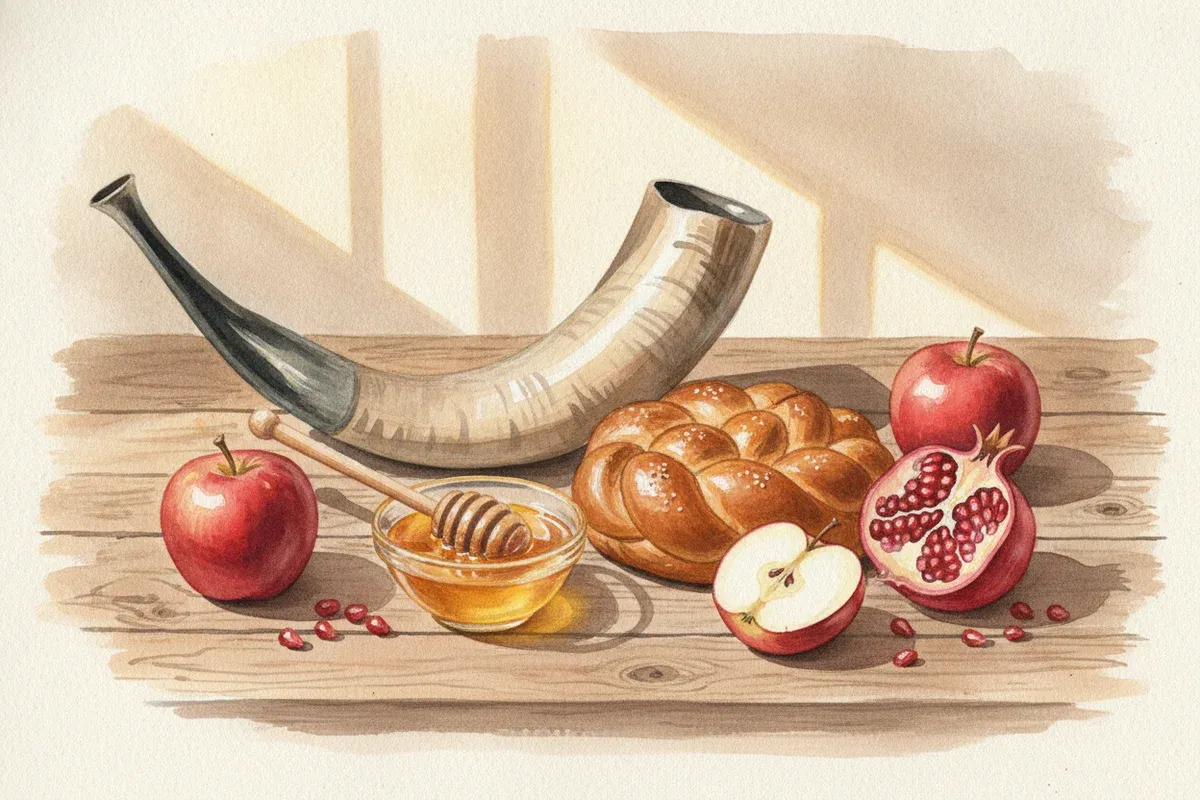
Read Leviticus 23:23–25 aloud—it’s short enough for a child to hear the whole command. Then make noise. Blowing a trumpet and making noise is the only command from Scripture on how to celebrate this feast, so let the children obey it thoroughly. If you have a shofar, wonderful. If not, a trumpet, a party horn, or any noisemaker will do.
Traditionally the shofar is blown in three distinct patterns, and each one preaches a sermon without words:
Tekiah—one long, straight blast. The coronation sound: the announcement that the King is on the throne.
Shevarim—three broken, wailing blasts. The sound of introspection and repentance—a heart breaking open before God.
Teruah—nine short, staccato blasts. The alarm: wake up! Be alert! The King is near!
Let the children try all three patterns with their noisemakers, then ask them which one sounds like a coronation, which one sounds like crying, which one sounds like an alarm clock. They’ll match them correctly—and they’ll never forget them.
2. Color and craft the story
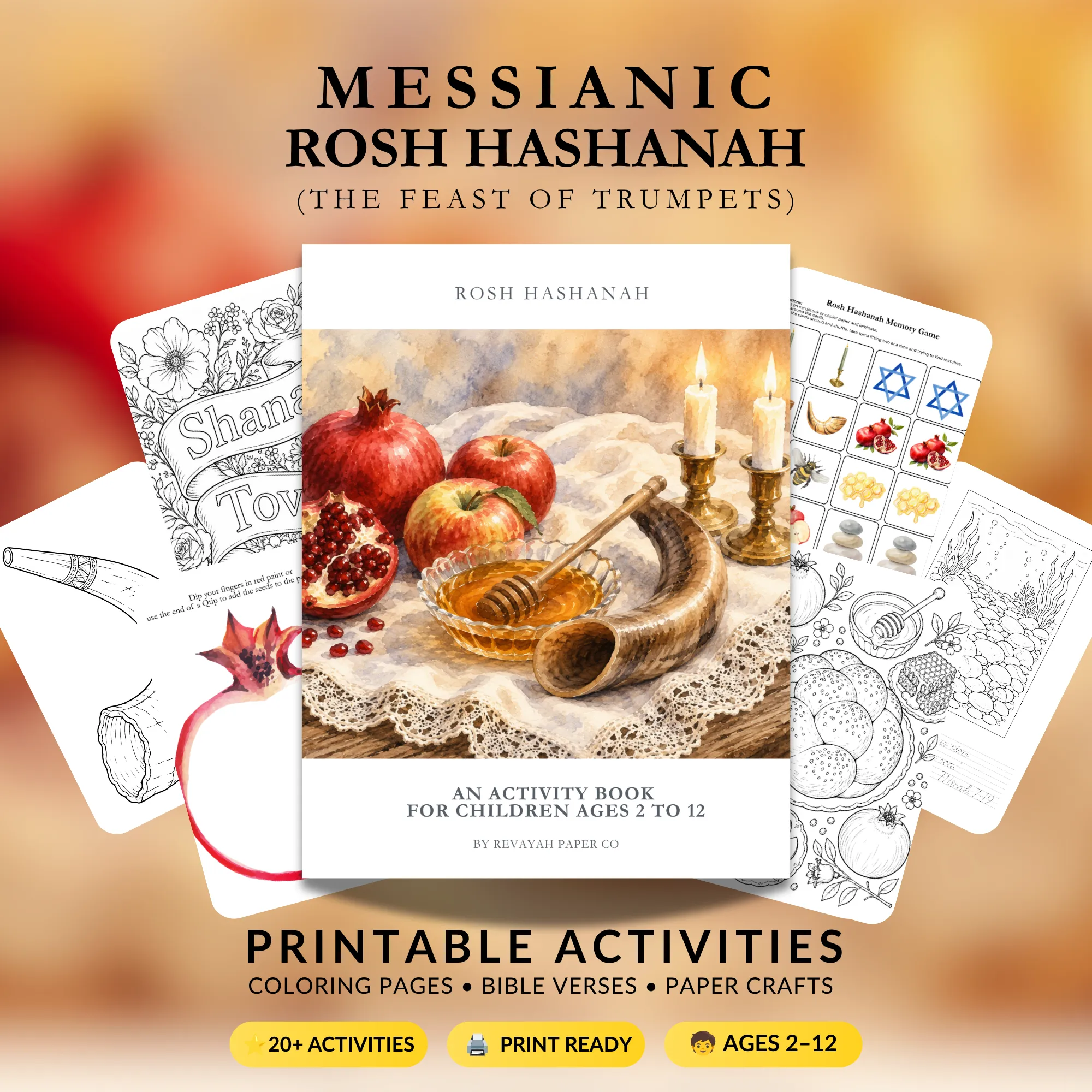
Bring out our Messianic Rosh Hashanah activity bundle—coloring pages and crafts that put the shofar, the apples and honey, and the feast’s images into the children’s hands. This feast’s meaning lives in its objects: a ram’s horn, a crown, apples, honey, a round loaf of bread. Every one is simple enough for a small child to color, cut, and hold—and each one is a doorway back into the four themes. A paper shofar on the table all week keeps the question alive: what does the sound mean? Hands busy, ears open.
3. Share a sweet meal together
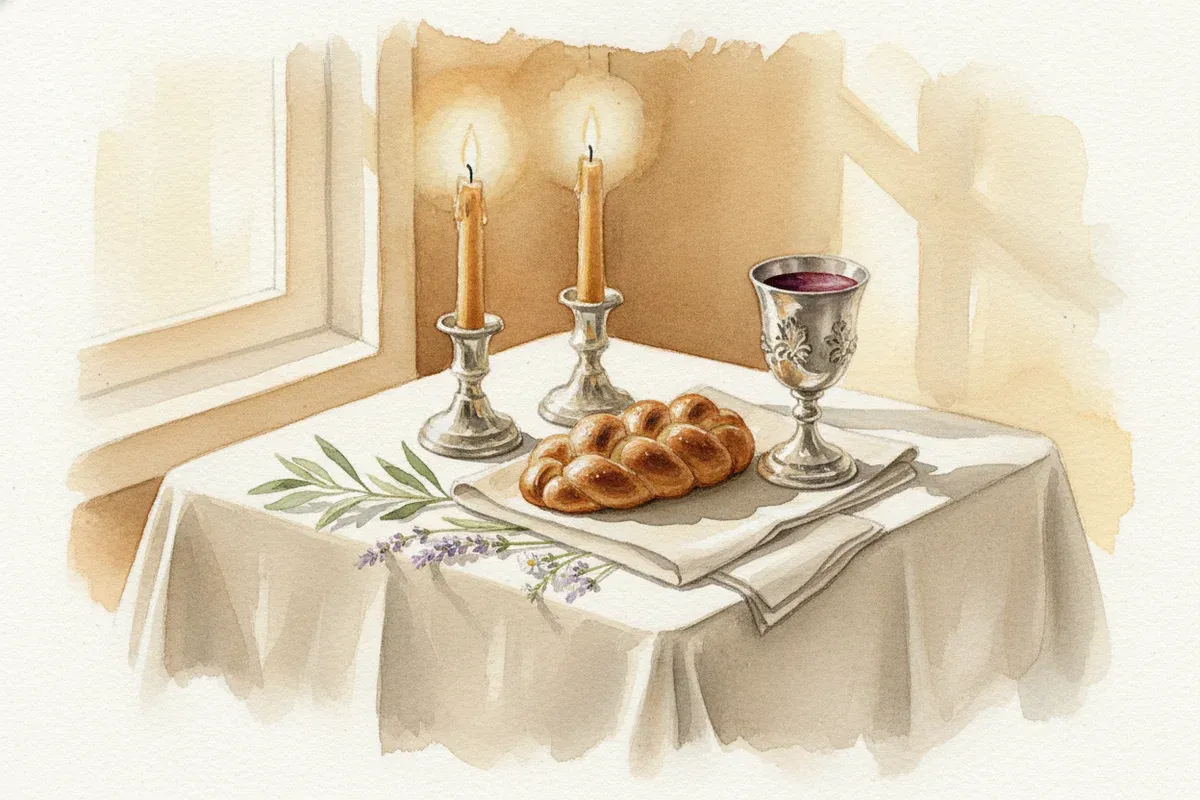
It’s Jewish tradition to eat a festive meal for Rosh Hashanah—typically a whole fish like salmon, along with symbolic foods: apples and honey, glazed carrots, and the round challah (braided bread baked round for this feast). Because the day is a Sabbath, candles are lit on the evening before, with a blessing said over the grape juice and the bread, thanking the God who graciously gives us everything we need.
Arrange apple slices on a plate around a bowl of honey and let everyone dip—a symbolic hope for the sweet new year we’re entering. Even toddlers can dip an apple, and that taste of honey is the feast’s meaning in a single bite: our God is good, and we’re asking Him for a sweet year. As you enjoy the meal, share stories of how our Father and King was with you in the previous year, and what you’re expecting Him to do in the year ahead—and children should get a turn. Ask them: where did you see God come through this year?
Two greetings to teach: Shanah Tovah U’Metukah—“may you have a good and sweet new year”—and the simpler L’Shanah Tovah. Children love having a real Hebrew greeting to say all week.
4. Hold a Tashlich ceremony
Tashlich (Hebrew for “you will cast”) is a beautiful part of a Rosh Hashanah celebration that even the youngest children can do with their whole bodies. You need a small body of water—a beach, lake, pond, or creek—a few small rocks or pebbles, a Bible, and a willing heart. Gather near the water. As each person holds a stone, think of something you’d like to leave behind as the new year begins—bitterness toward someone, anger from unmet expectations, a sin you keep returning to. Then read Micah 7:18–19 aloud: “Who is a God like You, pardoning iniquity... He will again have compassion on us. He will subdue our iniquities, and You will cast all our sins into the depths of the sea.” Say a short prayer, then throw the stones into the water.
Our sins are like stones at the bottom of His ocean—never to be found again. Children remember what they do with their bodies, and a stone disappearing beneath the water is forgiveness they can see. For a classroom without water access, children can write or draw what they want to leave behind and drop the papers into a bin that gets emptied—the point is the letting go.
5. Prepare hearts for Yom Kippur (the Ten Days of Awe)
The Feast of Trumpets doesn’t end when the meal is cleared—it opens a door. With Yom Teruah begin the Ten Days of Awe, counting down to Yom Kippur, the Day of Atonement. The shofar was the wake-up call; the ten days are what we do once we’re awake. Keep it simple and gentle with children: each evening, one quiet question—Is there something you need to say sorry to God for? Is there someone you need to make things right with? The stone went into the water; now we live like it did. This isn’t about making children anxious—it’s about teaching them that our King is merciful, near, and glad when we return to Him.
Printable Feast of Trumpets Resources
Rosh Hashanah Activities and Printables for Kids
Hand-illustrated by our family. Print at home, print at your congregation, use them year after year.
Looking for more of the appointed times? Browse all of our printables in the shop to walk through the whole year of biblical feasts together.
A Seven-Day Reading Plan for the Feast of Trumpets
Read one passage a day in the week around the Feast of Trumpets—or one per class session. Together they sound out the whole feast.
Leviticus 23:23–25 — The command itself: rest, gather, and a memorial of blowing. Notice how short it is—then ask the children why they think God wanted a whole day of trumpet blasts.
Numbers 29:1 — The parallel command: “a day of blowing the shofar.” Two witnesses in the Torah to one loud day.
Isaiah 55:6–7 — “Seek Adonai while He is available, call on Him while He is still nearby.” The Elul verse—the King is in the field. Retell the story as you read it.
Genesis 22:1–14 — The binding of Isaac, traditionally read at this feast—because at the crucial moment, God provides a ram caught by its horns. Every shofar is a ram’s horn, and every blast recalls the God who provides the substitute.
Micah 7:18–19 — The Tashlich verses. Who is a God like ours, who casts our sins into the depths of the sea? Read it at the water’s edge if you can.
Psalm 81:3–4 — “Blow the shofar at the new moon... for it is a statute for Israel.” The feast in Israel’s songbook.
Matthew 24:30–31 — The Son of Man coming with power and great glory, gathering His people “with a great trumpet.” The feast’s forward edge: one day the shofar we practice with will be the sound we’ve been waiting for.
The Traditional Synagogue Readings
Rosh Hashanah is traditionally kept as a two-day feast, and it is Jewish tradition to read a set portion of Scripture in the synagogue on each day. If your family wants to read along with Jewish communities around the world, here is the traditional plan.
First Day
Torah: Genesis 21:1–34, which recounts the announcement of Isaac’s birth to Sarah and the exile of Hagar and Ishmael, along with Numbers 29:1–6, the command for the day of blowing.
Haftarah: 1 Samuel 1:1–2:10
B’rit Hadashah: Romans 8:31–39
Second Day
Torah: Genesis 22:1–24, known as the Akedah or the Binding of Isaac, along with Numbers 29:1–6.
Haftarah: Jeremiah 31:2–20
B’rit Hadashah: 1 Thessalonians 4:13–18
These readings come from the traditional festival cycle—you can find them, along with prayers and more resources for keeping the feast, at the Shalom app’s Rosh Hashanah guide.
The Hebrew month of Elul is a 30-day season of repentance before the fall feasts and high holy days. Simple, hands-on ways to teach your children teshuvah—turning back to God.
The Feast of Trumpets opens the fall appointed times—a season of awakening, remembrance, and return. The shofar opens the Ten Days of Awe, leading to Yom Kippur, the Day of Atonement. Five days after that comes Sukkot, the joyful Feast of Tabernacles. Together these are the three fall feasts, the High Holy Days, and the trumpet is the sound that begins them all.
Questions are not interruptions to the lesson. They are the lesson. Here are answers you can give in your own words, at home or in the classroom.
What is the Feast of Trumpets?
It's the biblical feast on the first day of the seventh Hebrew month, commanded in Leviticus 23—a day of rest, gathering, and blowing trumpets. The Bible calls it Yom Teruah, the "day of blasting or shouting." The shofar announces that God is King, wakes us up to return to Him, and reminds us that Messiah will one day return with a great trumpet sound.
Why does Rosh Hashanah have two names?
Yom Teruah is the biblical name—the day of blasting. Rosh Hashanah means "head of the year," a name that came later, during the Babylonian exile, when the day became the start of the Jewish civil new year. Two names, one feast: God's day of trumpets, and the spiritual new year.
What is a shofar?
A shofar is a trumpet made from a ram's horn. It's the instrument God's people have blown for thousands of years—at Sinai, in battle, and at this feast. Its sound is a wake-up call: the King is near.
Why do we blow the shofar on Rosh Hashanah?
Making noise with a trumpet is the only command Scripture gives for how to celebrate this day! The blasts crown God as King, call our hearts to repentance, and wake us up from spiritual sleepiness. There are three traditional patterns: tekiah (one long coronation blast), shevarim (three wailing blasts of repentance), and teruah (nine short alarm blasts that say wake up!).
Why do we dip apples in honey on Rosh Hashanah?
It's a sweet hope for a sweet new year. As we begin the year, we're asking God—who is good and generous—to make it a good and sweet one. That's also why we greet each other with Shanah Tovah U'Metukah: "may you have a good and sweet new year."
Why do we throw stones in the water at Tashlich?
Tashlich means "you will cast." It comes from Micah 7:19, where God promises to cast all our sins into the depths of the sea. When we throw a stone into the water while thinking of something we're leaving behind, we're acting out God's forgiveness: our sins sink like stones to the bottom of His ocean, never to be found again.
Who is the King in the field?
It's a Jewish picture of the month before this feast. A king usually stays far away in his palace—but in the month of Elul, the King comes out into the fields where everyone can meet him. It means God has drawn near and wants us to come to Him. So we get our hearts ready, the way you'd get ready if a king were walking through your own backyard.
What comes after the Feast of Trumpets?
The shofar opens the Ten Days of Awe—ten days of searching our hearts and returning to God—leading to Yom Kippur, the Day of Atonement. Five days after that comes Sukkot, the joyful Feast of Tabernacles. Together these are the three fall feasts, the High Holy Days, and the trumpet is the sound that begins them all.
One Step at a Time
You don’t have to do all of this. Pick one thing: tell the King-in-the-field story and blow something loud, or dip apples in honey at dinner, or take a walk to a creek with a pocketful of stones. The feast will do the rest.
May the sound of the shofar wake every heart at your table, may your year be good and sweet, and may every child you teach learn to listen for the trumpet of the King.
L’Shanah Tovah!
Free Family Guide
Begin with a weekly Sabbath rhythm
Before the annual feasts, there is the weekly one. Subscribe and we'll send you our free Sabbath Family Starter Guide—candles, blessings, a simple Friday-evening rhythm, and Scripture to root your family in the seventh day.
✦Begin a weekly Sabbath rhythm this Friday
✦Hand-illustrated, hand-crafted, and free
✦Designed for families with young children
Send me the free Sabbath Family Starter Guide
You'll also receive occasional notes from our family on living the biblical calendar with little ones. We never sell or share your information. Unsubscribe anytime.

 Biblical Feasts