 Homeschool
6 min read
Why We Homeschool With the Biblical Calendar
How the biblical feasts became the anchor of our homeschool year — and gave our children a living framework for understanding Scripture that no textbook could.
Read More →
Biblical Feasts · Sukkot · Feast of Tabernacles
You don’t need a backyard, a building permit, or a degree in Jewish studies to teach children Sukkot. You need a shaky little shelter, a good meal, and a rooted confidence in the God who always takes care of His people. Add hand-illustrated Messianic printables and a simple five-step rhythm for the most joyful week on God’s calendar, at home or in the classroom.
Free Biblical Feast Printables
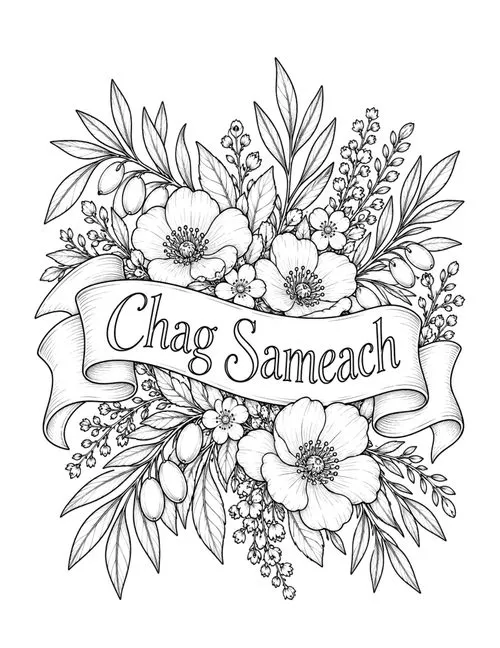
A hand-illustrated Chag Sameach banner from our Sukkot bundle, free for your family. Color it and hang it in the sukkah.
Sukkot, the Feast of Tabernacles, is the last of God’s seven appointed times in Leviticus 23. It begins on the fifteenth day of the seventh Hebrew month, Tishrei, five days after Yom Kippur, the Day of Atonement, and exactly seven months after the Passover seder. Scripture gives the command plainly: “On the fifteenth day of this seventh month is the Feast of Sukkot, for seven days to Adonai. On the first day there is to be a holy convocation.” (Leviticus 23:34–35).
The fall feasts are a sequence. The shofar of Rosh Hashanah wakes us up, the Ten Days of Awe turn us back to God, Yom Kippur covers us, and then Sukkot throws the party. It is the only feast God commanded to be celebrated with joy. Deuteronomy 16:14–15 says it three times: rejoice, rejoice, be altogether joyful. And what a fun season it is!
The word sukkah means booth or hut: a shaky, impermanent structure, like the tents Bnei-Yisrael (the children of Israel) lived in for forty years after God brought them out of Egypt. Another word for sukkah is tabernacle, which is also the word for the tent that housed the ark of the covenant, where God’s presence dwelt right in the middle of the camp. The same word describes where the people lived and where God lived. That is not an accident.
For those of us who follow Yeshua, the feast carries one more layer. On the last and greatest day of Sukkot He stood up in the Temple and cried out, “If anyone is thirsty, let him come to Me and drink” (John 7:37). He is the living bread from heaven and the living water. He is the one who tabernacled among us. And one day He will return to set the world right, and we will feast with Him for seven days at the wedding supper of the Lamb, just as we have practiced every year during Sukkot (Revelation 19:7–9).
Every other feast has a food or a sound. Sukkot has a place. Children learn with their whole bodies, and a child who has eaten dinner in a wobbly hut she decorated herself will remember Sukkot for the rest of her life. The command in Leviticus is literally to “dwell in booths.” So dwell in one.
The whole feast in one sentence for children: Sukkot is the week we live in a little shelter to remember that God took care of His people in the wilderness, and He still takes care of us today.
Four simple themes run through the week, and they are the four things you are teaching:
This is the story every teaching step draws from. Read it once yourself before you teach. The sukkah craft and coloring pages make far more sense when the adult in the room can tell the wilderness story from memory.
A rescued people with nowhere to live. God had just brought Bnei-Yisrael out of four hundred years of slavery in Egypt. They walked through the sea on dry ground. And then they were in a desert. No fields, no houses, no wells, no map. Just a few million people, their animals, and a God who had promised to bring them to a good land. They lived in sukkot, temporary shelters made from whatever was on hand. God later said this is exactly why He wants His people to live in booths for a week each year: “so that your generations may know that I had Bnei-Yisrael to dwell in sukkot when I brought them out of the land of Egypt” (Leviticus 23:43).
Bread from heaven. Every morning, when the dew lifted, there was a thin flaky bread on the ground. They called it manna, which is basically Hebrew for “what is it?” Each family gathered what they needed for the day. On the sixth day, God gave a double portion so no one had to gather on Shabbat. For forty years, nobody in that camp went without bread (Exodus 16).
Water from the rock. In a desert with no water, the people were ready to give up. God told Moses to strike the rock at Horeb, and water poured out for the whole nation (Exodus 17:1–7). Paul later said the rock was Messiah (1 Corinthians 10:4). Keep that in your pocket for Step 4.
Clothes and sandals that never wore out. Deuteronomy 8:4 says it plainly: “Your clothing did not wear out on you, nor did your foot swell these forty years.” Children love this one. Ask them how long their shoes last.
A presence that showed the way. A pillar of cloud by day and a pillar of fire by night went ahead of the camp. When it moved, they moved. When it stayed, they stayed put. God’s tent, the Tabernacle, sat in the very center of the camp, with the tribes arranged around it. The people lived in booths, and God lived in a booth in the middle of them (Exodus 13:21–22; Numbers 9:15–23).
The harvest. Sukkot also lands at the end of the harvest year in the land of Israel, when everything is gathered in. Exodus 23:16 calls it the Feast of Ingathering. So the feast holds two things at once: God provided in the wilderness when we had nothing, and God provided in the land when we had everything. The same God sustains us in both seasons.
Three Hebrew words to teach here: Sukkah (soo-KAH), a booth, and its plural Sukkot (soo-KOTE), which is also the name of the feast. And Chag Sameach (khag sah-MAY-akh), “joyful festival,” the greeting you will hear all week.
This feast holds more story than most people expect: a rescued nation, bread on the ground, water from a rock, a cloud you could follow, and a Rabbi standing up in the Temple to shout. Here is the rhythm, five simple steps, for the deck, the yard, or the reading circle. Adapt freely for your family table or your classroom.
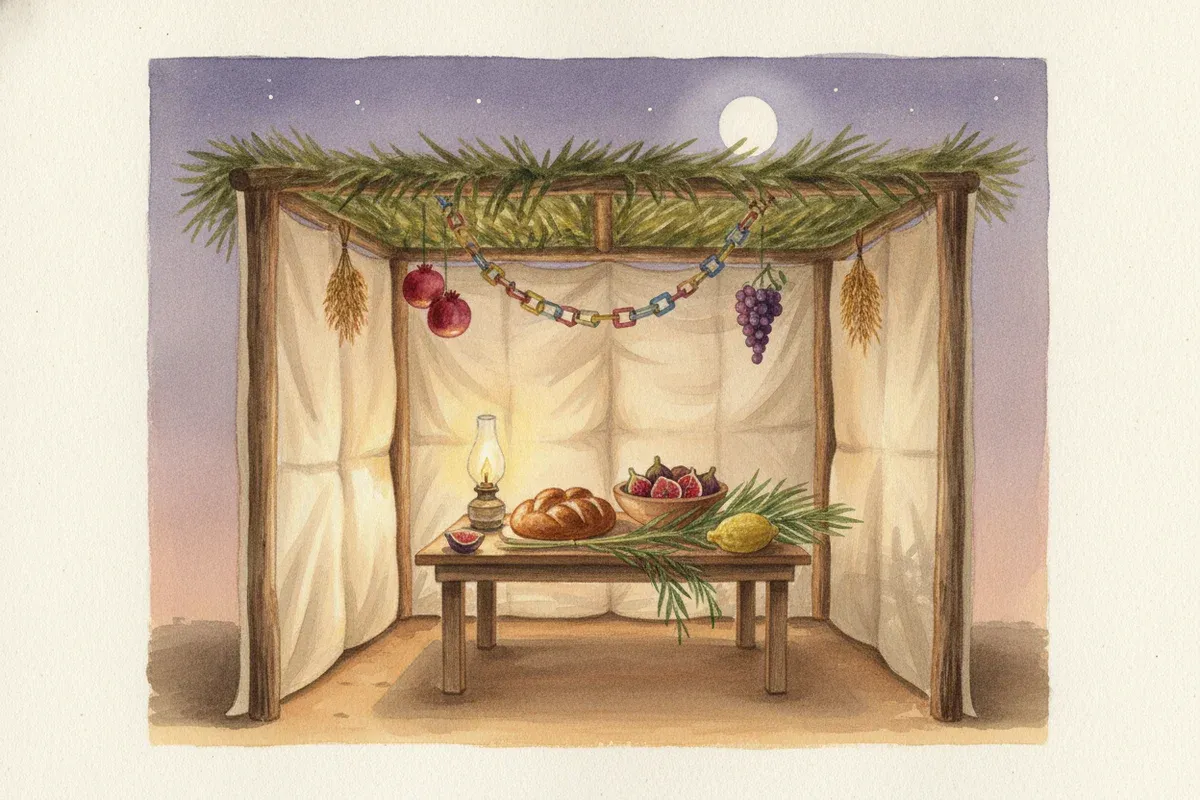
Before you explain anything, build a sukkah. It does not need to be perfect. Four posts and a sheet on the deck. A tent in the yard. In a classroom, a blanket fort over a table or a cardboard-box hut in the corner. Let the children decorate it with branches from local trees, colorful pictures they have made, fruit, paper chains, flowers. Then have at least one meal or snack inside it. If you can, do it after dark. Sukkot always begins at the full moon of the seventh month.
The sukkah is supposed to be temporary and a little flimsy. That is the point. Traditionally the roof is made of cut branches (called s’chach), loose enough that you can still see the stars through it. A sukkah with a solid roof is not a sukkah. It is a shelter that reminds you that you are not the one keeping yourself safe. The Sukkot activity bundle has a paper sukkah to build and furnish, and a STEM challenge where children build a miniature one and test it against wind and water. The nature scavenger hunt turns gathering decorations into an adventure.
Inside the sukkah, tell the story from the section above. Bread on the ground every morning. Water gushing out of a rock. Shoes that lasted forty years. A cloud you could follow. Ask the children: If you had to live in a tent for forty years in the desert, what would you be worried about? Let them list it. Food, water, getting lost, clothes wearing out. Then go back through their list and show them that God handled every single thing on it.
Children tend to hear the wilderness as a punishment story. Flip it. The wilderness is where God showed His people, every single morning, that He would take care of them. That is a story a child can carry into a scary week at school. The Israelites complained constantly, and God still fed them. Do not hide that from children. It is good news. His provision in Exodus 16 comes right after the grumbling, not as a reward for good behavior. He takes care of His people because He is their Father, not because they earned breakfast.
Let their hands work while the story settles. The bundle has a wilderness camp coloring page, a harvest basket to color or fill with playdough fruit, and Leviticus 23:40 copywork at three levels so every child in the room can write the same verse.
This is the heart of the feast for our family, and it works just as well in a classroom. Go around the sukkah and have every person, adult and child, answer three questions: How has God been there for you this year? What is He teaching you? What are you looking forward to? Write the answers down. Keep them. Next year, read last year’s answers before you add new ones.
Sukkot is a feast of remembrance, and remembrance is a muscle we exercise year after year. Children who hear their parents and teachers name specific things God did, a healed body, a provided job, a friend at the right time, learn that God is not only in old stories. He is in their story. Sharing stories of God’s faithfulness strengthens everyone’s faith, including yours.
In our house, one of our Sukkot stories is about one of our daughters who fell off a trampoline during Sukkot and spent a night in the pediatric ICU with a skull fracture. The next day she walked out with her hearing perfect and no bleeding on her brain. We tell it every year through tears. You will have your own. And here is the thing to teach children: many times He is working even when we do not have eyes to see. Some of the stories will not look like provision until years later. Tell those too.
Read John 7:37–38 aloud, in the sukkah if you can: “On the last and greatest day of the Feast, Yeshua stood up and cried out loudly, ‘If anyone is thirsty, let him come to Me and drink. Whoever believes in Me, as the Scripture says, out of his innermost being will flow rivers of living water.’” Then read Isaiah 12:2–3: “With joy you will draw water from the wells of salvation.” Ask: What did the people drink in the desert? Where did it come from? (A rock.) Who does Paul say the rock was? (Messiah, 1 Corinthians 10:4.) So when Yeshua says “come to Me and drink,” what is He telling them? Pour a cup of water and let every child drink it.
The manna and the water from the rock are pictures. Yeshua tells us what the pictures were of. He is the living bread from heaven and the living water that nourishes our souls and gives us everlasting life. Children who have just heard about the rock in the desert can now see the One the rock was pointing to.
The seventh day of Sukkot is called Hoshana Rabbah, “the Great Salvation.” In the days of the Temple, each day of the feast the priests drew water from the Pool of Siloam and carried it up to pour out on the altar while the people sang Isaiah 12 and waved their branches. It was the most joyful ceremony of the whole year, and on the seventh day it reached its climax. That is the moment John 7 describes: with water being poured out in front of the whole nation, Yeshua stood up and said the water they were really thirsty for was Him. Nobody standing there could have missed it.
End the week by looking ahead. Tell children that the fall feasts point forward, not just back. One day Yeshua will return to set the world right, to bring justice and make all things new, and when He does, we will celebrate the great feast with Him for seven days. The prophet Zechariah says that every nation will come to Jerusalem to celebrate Sukkot with the King (Zechariah 14:16). At your last meal in the sukkah, raise a glass, juice for the kids, and toast: To the King! The one who has come, and the one who will come again.
Children need a hope that is bigger than this week. A sukkah is temporary. So is everything else they can see. Sukkot teaches them, in a way they can touch, that the impermanent things are not the real things, and that the permanent thing coming is a feast, not a fear.
Sukkot is the one fall feast still waiting for its full fulfillment. Passover, Firstfruits, and Shavuot found theirs in Yeshua’s death, resurrection, and the giving of the Spirit. Trumpets, Atonement, and Tabernacles still anticipate His return. And then there is the bonus: after seven days, God gives us an eighth day, Shemini Atzeret, and with it Simchat Torah, “the Joy of the Torah,” when we finish reading Deuteronomy, open a new scroll to Genesis, and dance around the room with the very words of God. God’s words to us never end. What do we do with that? We celebrate with joy.
Printable Feast of Tabernacles Resources
Hand-illustrated by our family. Print at home, print at your congregation, use them year after year.
The Complete Bundle
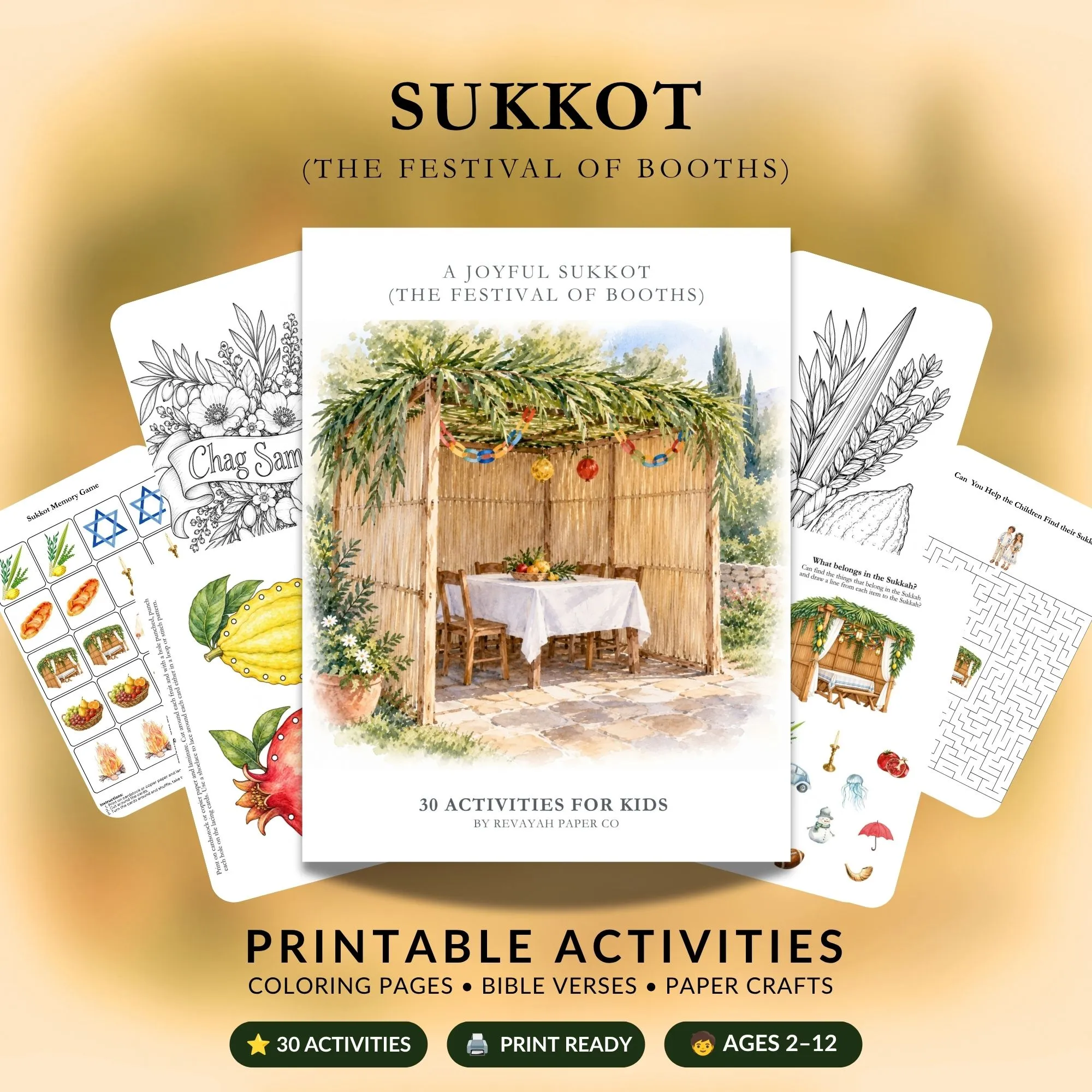
30 activities for ages 2 to 12 in one downloadable PDF: six coloring pages, a build-your-sukkah paper craft, a five-part sukkah STEM challenge, a word search and three mazes, a memory game, lacing cards, Hebrew number clip cards, a nature scavenger hunt, bingo, and Leviticus 23:40 copywork for every level. Instant digital download, print ready, minimal prep.
Looking for more of the appointed times? Browse all of our printables in the shop to walk through the whole year of biblical feasts together. If you are teaching the fall season from the beginning, our Rosh Hashanah and Yom Kippur bundles carry the story from the shofar to the sukkah.
Read one passage a day through the seven days of Sukkot, or one per class session. Together they walk a child from the wilderness to the wedding feast.
For the eighth day (Shemini Atzeret and Simchat Torah): read the last verses of Deuteronomy (34:10–12) and then the first verses of Genesis (1:1–5), back to back. That is what happens in every synagogue on this night. God’s words never end. We just start again fresh.
Sukkot opens and closes with days of holy assembly, and it is Jewish tradition to read a set portion of Scripture in the synagogue on each of them. If your family wants to read along with Jewish communities around the world, here is the traditional plan.
First Day of Sukkot
Shemini Atzeret & Simchat Torah
These readings come from the traditional festival cycle. You can find them, along with prayers and more resources for keeping the feast, at the Shalom app’s Sukkot guide.
From the Journal
HomeschoolHow the biblical feasts became the anchor of our homeschool year — and gave our children a living framework for understanding Scripture that no textbook could.
Read More → Homeschool
A homeschool guide for families exploring Torah, the biblical feasts, and the Jewish identity of Yeshua—practical wisdom for every age and stage.
Read More → Biblical Feasts
The Hebrew month of Elul is a 30-day season of repentance before the fall feasts and high holy days. Simple, hands-on ways to teach your children teshuvah—turning back to God.
Read More →Sukkot is where the fall appointed times land. The season opens with the shofar’s wake-up call at Rosh Hashanah Resources for Kids, which begins the Ten Days of Awe. Those ten days of searching and returning lead to Yom Kippur Resources for Kids, the Day of Atonement and the holiest day of the year. Then, five days later, the fasting gives way to a whole week of living in booths and rejoicing. Solemn, then glad, in that order.
Explore our full library of Biblical Feasts for Kids, walk back to the spring feasts with our Passover Resources for Kids, or begin with the weekly Sabbath rhythm that holds the whole calendar together.
Questions are not interruptions to the lesson. They are the lesson. Here are answers you can give in your own words, at home or in the classroom.
Sukkot is the Feast of Tabernacles, the last of God's seven appointed times in Leviticus 23. For seven days, God's people live in little temporary shelters called sukkahs to remember how He took care of them in the wilderness after leaving Egypt. It is the most joyful week on God's calendar, and the only feast He commanded to be kept with joy.
A shaky, temporary hut, like a tent with a roof made of branches you can see the stars through. It is the kind of shelter the Israelites lived in for forty years in the desert. We build one and eat in it so we do not forget that God is the one who really keeps us safe.
So you can see the stars. The sukkah is not supposed to feel safe and solid. It is supposed to remind you that your house is not what protects you. God is. The Israelites slept under those same stars, and He took care of them every night.
Tabernacle is another word for a tent or booth. It is also the name of God's tent in the wilderness, where His presence lived in the middle of the camp. So the people lived in tabernacles, and God lived in a tabernacle right there with them. John 1:14 says the Word became flesh and tabernacled among us. Yeshua came and lived in a tent of skin and bone, right in the middle of us.
Manna, a thin, sweet bread that showed up on the ground every morning. The word manna means "what is it?" because that is what everybody said the first time they saw it. God sent it every day for forty years, with a double portion before Shabbat so nobody had to gather on the Sabbath.
Because that is the order God put them in. First the shofar wakes us up at the Feast of Trumpets. Then we search our hearts and return to God during the Ten Days of Awe. Then He covers our sins on Yom Kippur. And then, five days later, we celebrate, because it is finished. We were serious last week so we could be truly joyful this week.
On the last and greatest day of the feast, while the priests were pouring out water in the Temple, He stood up and cried out, "If anyone is thirsty, let him come to Me and drink." He was saying that the water from the rock in the desert was a picture of Him. He is the living water, and whoever believes in Him will have rivers of living water flowing out of their innermost being (John 7:37–38).
Yes. The prophet Zechariah says that when the King returns, every nation on earth will come up to Jerusalem to celebrate Sukkot with Him (Zechariah 14:16). And Revelation describes a great wedding feast for the Lamb. This week is practice. One day we will feast with our Messiah, and the shaky little sukkah will be a memory of when we were still waiting.
You do not need to do everything perfectly. Pick one story or activity. Build something shaky, eat one meal in it, and ask everyone at the table how God has been there for them this year. That is enough.
A child who has eaten dinner under the stars in a hut she decorated herself, listening to the grown-ups tell what God has done, will not forget what Sukkot is. And when she is old enough to read John 7, she will already know who was standing up in the Temple.
Chag Sukkot Sameach!
Free Sukkot Printable
Subscribe and we'll send you a hand-illustrated Chag Sameach (joyful festival) coloring page from our Sukkot activity bundle. Color it together and hang it where everyone who walks into the sukkah can see it.
Send me the free Sukkot coloring page
You'll also receive occasional notes from our family on living the biblical calendar with little ones. We never sell or share your information. Unsubscribe anytime.