How to Teach Your Children About Sukkot
 By Jon7 min read
Sukkot, the Feast of Tabernacles, is the most joyful week on God's calendar. Build a shaky sukkah, tell the wilderness story, show kids the living water.
Every fall, our deck gets a little strange.
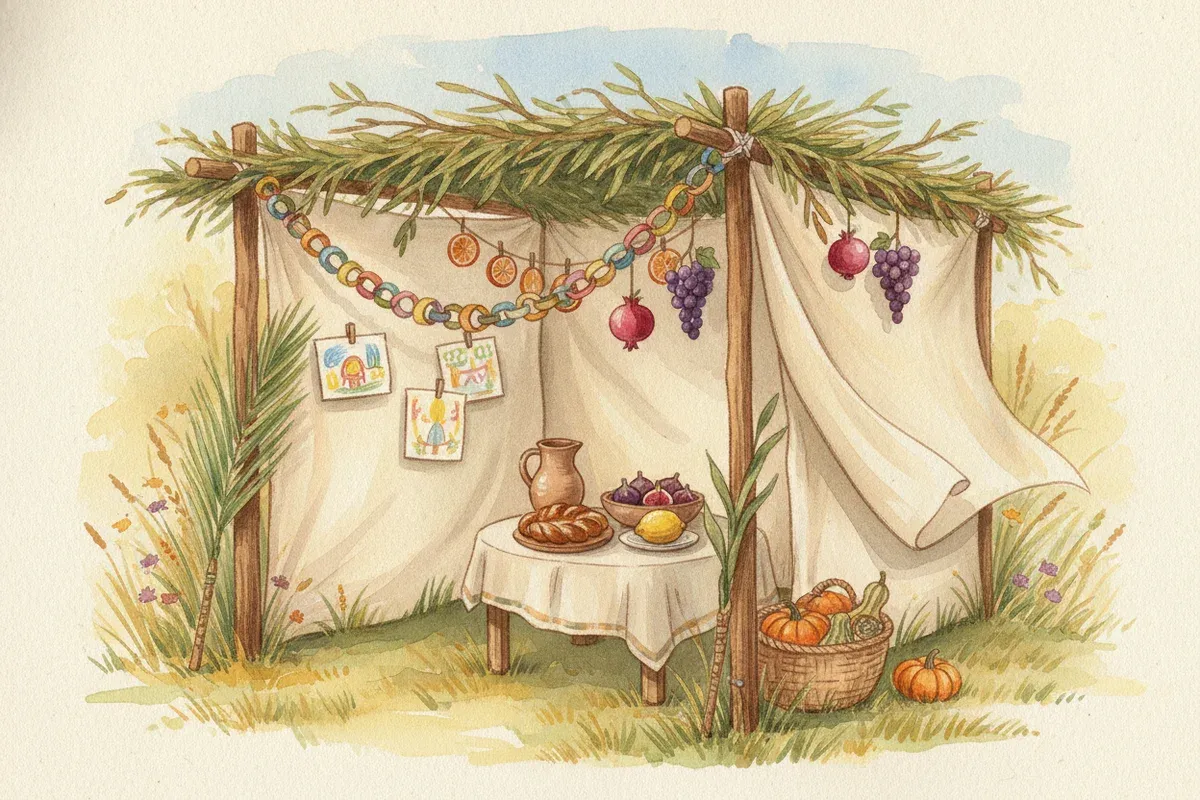
Four posts go up. A sheet gets tied between them. The roof is whatever branches the children can drag out of the yard, laid loose enough that you can still see the stars through the gaps. Paper chains. Crayon drawings pinned to the cloth. Fruit is often dangling from string. It wobbles when the wind picks up, and every year at least one child almost knocks it down.
That question is the entire lesson. And Sukkot is the week we get to answer it.
What is Sukkot? The meaning of the Feast of Tabernacles
Sukkot (soo-KOTE) is the Feast of Tabernacles, the last of the seven appointed times God gave to the Jewish people in Leviticus 23. Scripture gives the command plainly:
"Adonai spoke to Moses saying: 'Speak to Bnei-Yisrael, and say, On the fifteenth day of this seventh month is the Feast of Sukkot, for seven days to Adonai.'" (Leviticus 23:33–34)
The word sukkah (soo-KAH) means a booth or a hut: a shaky, impermanent structure, like the tents that housed the Israelites for forty years after God brought them out of Egypt. Another word for sukkah is tabernacle, which is also the word for the tent that held the ark of the covenant, where God's presence dwelt in the middle of the camp. The same word describes where the people lived and where God lived. That is not by accident, and it is the first thing worth telling your children.
Sukkot is the last of the fall feasts. The shofar (ram's horn) of Rosh Hashanah wakes us up, the Ten Days of Awe turn us back to God, Yom Kippur covers us, and five days later Sukkot throws the party. It is the one feast God commanded to be kept with joy. Deuteronomy 16 says it three times: rejoice, rejoice, be altogether joyful. If you are new to the whole cycle, our biblical feasts hub walks through each one and what it looks like with children.
So why do we celebrate Sukkot? God tells us Himself: "so that your generations may know that I had Bnei-Yisrael to dwell in sukkot when I brought them out of the land of Egypt" (Leviticus 23:43). Your generations. Sukkot was built for children from the start.
For those of us who believe Yeshua (Jesus) is Israel's promised Messiage, there is one more layer. Sukkot is the fall festival still waiting for its fulfillment. It looks ahead to the day Messiah will return to usher in the world to come, and to the initiate wedding supper of the Lamb, when we will feast with our Messiah after He establishes His throne in Jerusalem. Every year in the sukkah, we are practicing expectantly for that moment.
This year Sukkot begins at sundown on Friday, September 25, and runs for seven days.
Start with a shaky sukkah
Before you explain anything, build something.
It does not need to be impressive. Four posts and a sheet on the deck. A tent pitched in the yard. If you have no yard, a blanket fort over the dining table works, and the children will love it more (even if it may not be halachically accurate). Let them decorate it with branches from local trees, fruit, flowers, paper chains, and every picture they have made this month. Then eat at least one meal inside it. If you can, do it after dark. Sukkot always begins at the full moon of the seventh month, and the roof is supposed to let the sky in.
Traditionally the roof is made of cut branches, called s'chach (skhakh), laid loose enough that you can still see the stars. A sukkah with a solid roof is not a sukkah. The whole point is that it is not what keeps you safe.
Two Jewish Sukkot traditions worth adding while you build: the greeting Chag Sameach (khag sah-MAY-akh), which means "joyful festival" and which you will hear all week, and the lulav and etrog. The lulav is a bundle of palm, myrtle, and willow branches, and the etrog is a fragrant yellow citron. Together they are called the four species, and Leviticus 23:40 says to take them and rejoice before the Lord. Children love waving the lulav in all directions to say that God is everywhere.
If you want to put something in little hands while the big sukkah goes up, our Sukkot activities for kids bundle has a paper sukkah to build and furnish, a STEM challenge where children build a miniature sukkah and test it against wind and water, and a nature scavenger hunt that turns gathering decorations into an adventure. Thirty hands-on activities for ages two through twelve, and a free Chag Sameach coloring page to hang on the wall.
Tell the good parts of the wilderness story
Inside the sukkah, tell the story it was built to remember.
A rescued people with nowhere to live. A desert with no fields, no wells, no map. And then, every morning when the dew lifted, a thin sweet bread on the ground. They called it manna, which is Hebrew for "what is it?" Each family gathered what they needed for the day, and on the sixth day God gave a double portion so no one had to gather on Shabbat. For forty years, nobody in that camp went without bread. Their sandals never wore out. A pillar of cloud by day and fire by night showed them where to go, and when it moved, they moved.
Here is a simple exercise that works with every age. Ask: If you had to live in a tent in the desert for forty years, what would you be worried about? Let them make the list. Food. Water. Getting lost. Shoes wearing out. Then go back through their list, one item at a time, and show them that God handled every single thing on it.
Children (and adults!) tend to hear the wilderness as a punishment story. Let's flip that script. The wilderness is where God showed His people, morning after morning, that He would take care of them. The Israelites grumbled constantly and He fed them anyway. Do not hide that from children. It is good news. He takes care of His people because He is their Father and loves them, not because they did something to earn it.
Sukkot is a reminder that God will always take care of us. That is the sentence to send your kids to bed with.
Share your own stories of God's provision
This is the heart of the holiday for our family.
Go around the sukkah and have every person, adult and child, answer three questions: How has God been there for you this year? What is He teaching you? What are you looking forward to? Write the answers down. Keep them. Next year, read last year's answers before you add new ones.
Sukkot is a feast of remembrance, and remembrance is a muscle. Children who hear their parents name specific things God did this year, a healed body, a provided job, a friend who showed up at the right moment, learn that God is not only in old stories. He is in their story. And some of the stories will not look like provision until years later. Tell those too.
Show them the living water
Read John 7 aloud, in the sukkah if you can:
"On the last and greatest day of the Feast, Yeshua stood up and cried out loudly, 'If anyone is thirsty, let him come to Me and drink. Whoever believes in Me, as the Scripture says, out of his innermost being will flow rivers of living water.'" (John 7:37–38)
Then read the invitation from Isaiah that the whole feast echoes: "Ho, everyone who thirsts, come to the water, and you who have no money, come, buy and eat" (Isaiah 55:1).
Ask your children: What did the people drink in the desert? Where did it come from? (A rock.) So when Yeshua says "come to Me and drink," what is He telling them? Pour a cup of water and let every child drink it.
The manna and the water from the rock were pictures. Yeshua stood up in the Temple on the last day of Sukkot and told everyone what the pictures were of. He is the living bread from heaven and the living water. He is the one who tabernacled among us. Children who have just heard about the rock in the desert can now see the One the rock was pointing to.
Raise a glass to the King
End the week by looking ahead.
The prophet Zechariah says that when the King returns, every nation on earth will come up to Jerusalem to celebrate Sukkot with Him (Zechariah 14:16). One day Yeshua will come back to bring justice and make all things new, and we will feast with Him. This week is practice.
So at your last meal in the sukkah, when hearts are full and the little shelter has held up one more year, raise a glass. Juice for the children. And say it together:
To the King! The one who has come, and the one who will come again.
Your children will not remember every word you taught them this week. But they will remember the wobbly walls, the stars through the roof, and the night everyone at the table said out loud how God took care of them. That is how you teach your children about Sukkot.
Chag Sameach.
Common Questions
What is Sukkot?
Sukkot, also called the Feast of Tabernacles or Feast of Booths, is the last of the seven appointed times in Leviticus 23. For seven days God's people live and eat in a temporary shelter called a sukkah to remember how He cared for Israel in the wilderness after the Exodus. It is the one feast God commanded to be kept with joy.
When is Sukkot in 2026?
Sukkot 2026 begins at sundown on Friday, September 25, and continues through Friday, October 2. Hoshana Rabbah, the seventh day, falls on October 2, followed by Shemini Atzeret on October 3 and Simchat Torah on October 4. Sukkot always starts on the fifteenth of the Hebrew month Tishrei, five days after Yom Kippur.
What is a sukkah?
A sukkah is a small temporary hut with at least three walls and a roof of cut branches, called s'chach, laid loosely enough that you can see the stars through it. Families build one in the yard or on a deck, decorate it, and eat meals inside during Sukkot. Its flimsiness is the lesson: God, not the house, is what keeps us safe.
Why do we celebrate Sukkot?
Leviticus 23:43 gives the reason: "so that your generations may know that I had Bnei-Yisrael to dwell in sukkot when I brought them out of the land of Egypt." Sukkot remembers God's daily provision of manna, water from the rock, and clothes that never wore out during forty years in the wilderness, and it celebrates the fall harvest.
How do you teach Sukkot to kids?
Build a simple sukkah together (a sheet over four posts or a blanket fort works), decorate it, and eat at least one meal inside. Tell the wilderness story of manna and water from the rock, have each family member share one way God provided this year, read John 7:37–38 about the living water, and end the week with a toast to the King.
What did Yeshua say at Sukkot?
On the last and greatest day of the feast, while the priests poured out water in the Temple, Yeshua stood and cried out, "If anyone is thirsty, let him come to Me and drink" (John 7:37–38). He was declaring that the water from the rock in the desert pointed to Him. For Messianic families, Sukkot also looks ahead to His return and the wedding supper of the Lamb.